Five EU countries open talks with Rwanda on a hub for rejected asylum seekers
Austria, Denmark, Germany, Greece and the Netherlands aim for first transfers in 2027, with no signed deal, no cost figure and about 100 people at a time.
The story
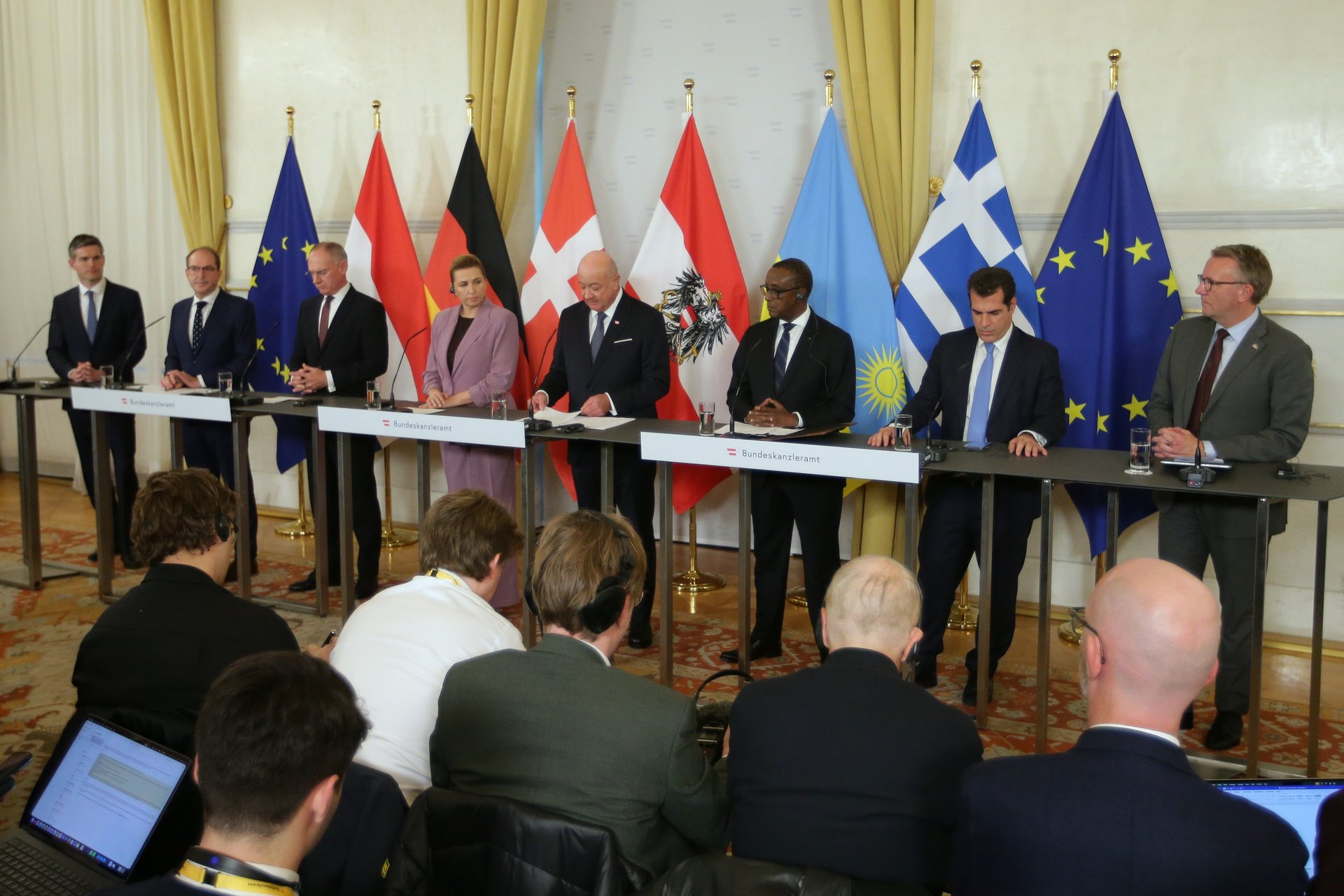
Five EU countries said on Nov 16 they will start talks with Rwanda on a "return hub" for rejected asylum seekers. The centre would hold about 100 people at a time, Euronews, the Guardian and Reuters reported.
- The five are Austria, Denmark, Germany, Greece and the Netherlands. Austria's government said talks start "immediately," Reuters reported. It aims for first transfers in 2027.
- Danish PM Mette Frederiksen called it "a game changer," Euronews reported. Rwanda's interior minister, Vincent Biruta, attended. No agreement is signed yet, AP and Al Jazeera reported.
- The hub is for people with removal orders who cannot be sent home, Euronews reported. Minors are excluded. The Guardian and the Telegraph said it would be an open centre without detention.
- Stays would last weeks or months. Reuters said "a few weeks," and the Guardian said "a couple of months." Afterwards people could settle in Rwanda, go home or move to a third country.
- The five countries pay the direct costs, Euronews reported. Biruta told Reuters: "We are not looking at really getting money or being paid." No report we read gave a total cost.
- The Guardian said the five are the first to use the EU's new returns law. French Green MEP Mélissa Camara called it "an agreement of shame," the Guardian reported.
How each side told it
The left led with the rights debate. The Guardian ran: "Five EU states announce plans for immigration 'return hubs' in Rwanda." It put "return hubs" in quote marks and quoted critic Mélissa Camara first. It placed Rwanda's human rights record in paragraph 12. Al Jazeera called the plan a "deal" in paragraph 1, then said in paragraph 7 that no formal deal is signed. Rights groups fill its paragraphs 23 to 30. The New York Times headline used a plainer verb: "Plan to Deport Migrants to Rwanda." The left told it as a test of rights law.


 Five European Countries Plan to Deport Migrants to RwandaThe New York Times

Missing context
Britain's earlier Rwanda plan was ruled unlawful by the UK Supreme Court in R (AAA and others) v Secretary of State for the Home Department [2023] UKSC 42, a unanimous judgment given on 15 November 2023. The court upheld a finding of "substantial grounds" for a real risk of refoulement, meaning people sent to Rwanda could be sent on to a country where they face harm. The EU plan rests on a different law, the EU Return Regulation, which got final approval in 2026. Anadolu Agency reported that it allows transfers only under agreements with non-EU countries that respect non-refoulement, and excludes unaccompanied minors.
What got buried
Two details split the coverage. The first is the buildings. The Telegraph said in paragraph 4 that the plan will "reportedly" reuse the Kigali buildings Britain paid for. The Guardian cited diplomatic sources in paragraph 8 saying it will not. Most others did not mention it. The second is scale. Reuters' explainer said the hub may take only a few hundred people a year, in paragraph 3. The EU received 669,365 asylum applications last year, Reuters added. Few headlines carried that comparison.
Why it matters to you
Run the Reuters numbers. Take 500 transfers a year, the top of "a few hundred." Against 669,365 asylum applications, that is about 0.07% of one year's total. Frederiksen said the point is deterrence: "The most important number is the number that we will never see." No report we read measured that effect. For UK readers, there is a cost benchmark. Britain paid Rwanda about £290m and sent four people, all voluntarily, the Telegraph reported. That works out to about £72m per person. If you pay tax in one of these five countries, ask for the cost figure before 2027.
The smaller the numbers, the louder the headlines tend to get.
All coverage
- Five EU countries announce plan to send rejected asylum seekers to Rwanda
- Five EU countries unveil plans for Rwanda deportation hub
- UK fails to rule out taking part in EU’s Rwanda deportation scheme
- Five European Countries Plan to Deport Migrants to Rwanda
- Five EU states announce plans for immigration ‘return hubs’ in Rwanda | European Union
 Five EU countries announce migrant deportation centre in Rwanda
 Germany and 4 other EU states set to announce new deportation hub scheme in Rwanda
 Europe Tonight: MEPs debate Rwanda deportation scheme announced by five EU countries
 EU nations unveil Rwanda deal for migrant return hub
 5 countries announce plan to deport failed asylum-seekers to Rwanda
 Five EU countries starting talks with Rwanda on deportation hub, Austria says
 Five EU countries unveil plans for Rwanda deportation hub
 Boris Johnson slams Labour for scrapping Tory's Rwanda deportation scheme: 'We didn't need Piddington!'
 5 European Countries Aim to Send Rejected Asylum-seekers to Center in Rwanda
 Failed EU asylum seekers will be deported to Rwanda
 EU states agree to ‘game changer’ Rwanda deportation plan UK ditched
What we read to write this
- Reuters (via AOL) Five EU countries starting talks with Rwanda on deportation hub, Austria says
- Reuters (via Yahoo) Explainer-Five EU countries' plan for a deportation hub in Rwanda
- KSL (AP) 5 European countries aim to send rejected asylum seekers to center in Rwanda
- Al Jazeera Why are five EU countries reviving plans to deport migrants to Rwanda?
- The Guardian (via AOL) Five EU states announce plans for immigration 'return hubs' in Rwanda
- The Telegraph (via AOL) Failed EU asylum seekers will be deported to Rwanda
- Euronews (via Yahoo) Five EU countries unveil Rwanda deportation plan in migration crackdown
Loading the discussion.