Centre tells Supreme Court it may form a panel to review UGC equity rules
Right-leaning outlets carried most of the coverage. Several said a panel was set up. The Solicitor General said one was being considered.
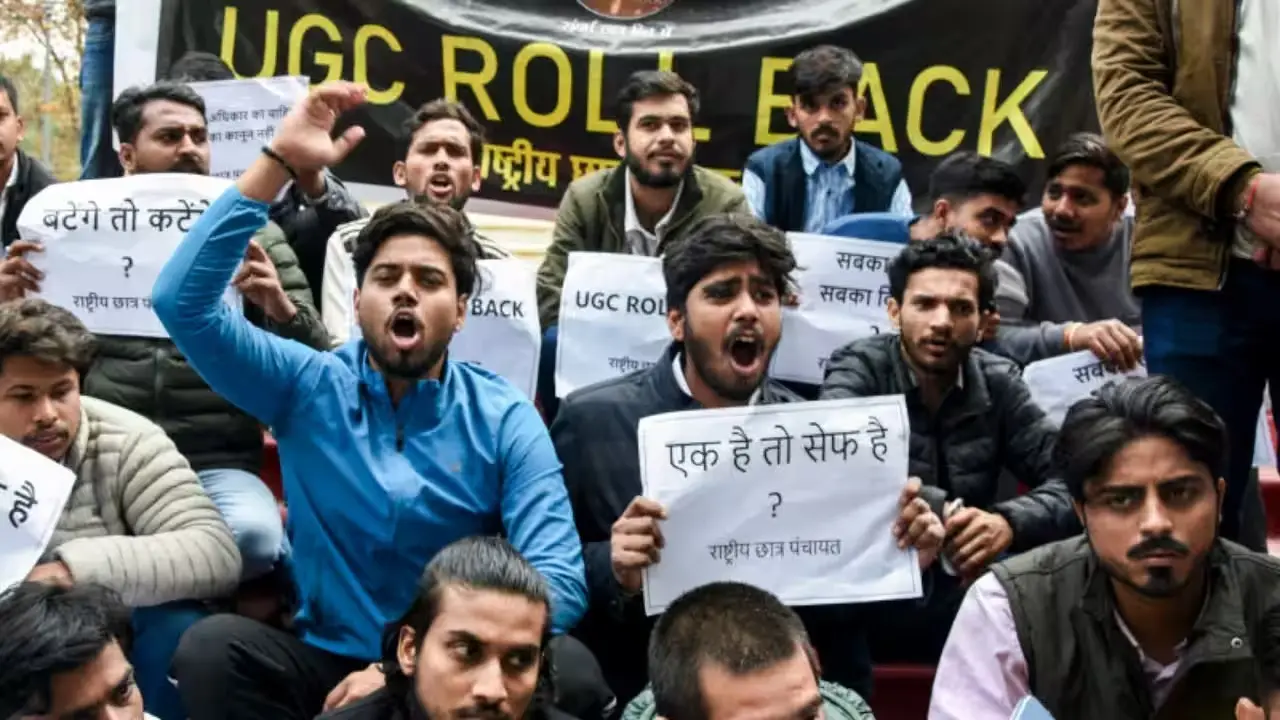
The story
Solicitor General Tushar Mehta told the Supreme Court on 5 November that the government "is contemplating appointing a committee" on the UGC equity rules. Of 13 outlets with headlines on it, 8 lean right.
- The UGC notified new equity rules for colleges on 13 January 2026. They replaced rules from 2012.
- The rules require equity committees, Equal Opportunity Centres, helplines and penalties for colleges that do not comply.
- On 29 January, a bench led by CJI Surya Kant stayed them. It called the rules prima facie "vague" and "capable of misuse," SC Observer reported.
- Petitioners objected that the caste clause covers only SC, ST and OBC members. Their plea called this a "hierarchy of victimhood," Verdictum reported.
- On 20 August, the Centre said the rules were under consideration. The court gave it four weeks, The Leaflet reported.
- On 5 November, CJI Kant asked, "Why don't you revisit the UGC Regulations?" Verdictum reported.
- Mehta replied that the government was contemplating a committee. "Nobody should have any apprehension," he said, Business Today reported.
- The case was adjourned for four weeks. The reports we read don't give an exact date or name any panel members.
- Reports differ on the bench. Verdictum named two judges. Outlook added a third, Justice V. Mohana.
How each side told it
Left coverage was thin. Of the 10 left-leaning outlets we track, two carried it. National Herald ran "UGC rules row: Centre mulls review panel, months after Supreme Court stay." It called the rules "controversial" and wrote "Modi government." It paraphrased Mehta in paragraph 2. In paragraph 8, it traced the case to the deaths of Rohith Vemula and Payal Tadvi. It alone noted a dropped draft clause on false complaints. Deccan Herald put the hearing second in its evening brief headline, using the word "Considering."
Missing context
The UGC (Promotion of Equity in Higher Education Institutions) Regulations, 2026, were notified on 13 January 2026. Regulation 3(1)(c) defines caste-based discrimination as discrimination against members of the Scheduled Castes, Scheduled Tribes and Other Backward Classes. Regulation 3(1)(e) is broader. It covers discrimination against any stakeholder on grounds including religion, race, caste, gender, place of birth and disability. At the 29 January hearing, Justice Joymalya Bagchi asked whether 3(1)(c) was redundant given 3(1)(e). The Supreme Court used Article 142 to keep the 2012 regulations in force until further orders.
What got buried
The verb is the buried story. Mehta said "contemplating," per Verdictum and Business Today. Republic, ThePrint's ANI copy and News On AIR said the panel was set up. No committee has been named, National Herald and The Week reported. The other detail is timing. The Centre first said the rules were under consideration on 20 August. In the reports we read, only National Herald, The Pioneer and The Week noted that date. None of the 5 November reports we read cited UGC complaint data.
Why it matters to you
If you study at an Indian college, the 2012 rules still apply while the stay holds, SC Observer reported. UGC data reported by The Crossbill shows caste-discrimination complaints rose from 173 in 2019-20 to 378 in 2023-24. That is 205 more complaints a year, a rise of about 118%. A UGC official said greater awareness explains part of the rise. Over those five years, 1,052 of 1,160 complaints were resolved, about 91%. The next hearing is about four weeks after 5 November. Until then, the 2012 rules govern how a complaint like yours is handled.
One verb can change what a reader thinks happened.
All coverage
 DH Evening Brief | SC says 24-hour period begins from detention, not formal arrest; Considering panel to re-examine UGC 2026 regulations: Centre to SC
 UGC rules row: Centre mulls review panel, months after Supreme Court stay
 May form panel to review UGC equity rules: Centre to Supreme Court
 Centre to set up panel to revisit UGC equity regulations, Supreme Court told | India News
 Centre plans committee to revisit UGC’s 2026 equity rules after Supreme Court intervention
 Centre considers committee to revisit UGC equity regulations, tells Supreme Court
 UGC rules on caste bias and ragging: SC gives Centre more time to review norms
 UGC Equity Regulations: Centre Mulls Committee To Review Rules, Tells Supreme Court
 Centre mulls Special Committee to review UGC's 2026 equity rules after Supreme Court stay
 UGC Regulation Row: SC calls for protection of all students; Centre assures review through a panel on new regulation
 UGC Equity Rules Row: Centre Sets Up Panel To Rework Controversial 2026 Regulations After SC Puts Them On Hold
 Centre Tells Supreme Court It May Form Panel To Revisit UGC Equity Rules 2026 Amid Concerns Over Student Exclusion
 UGC Equity Regulations 2026: Centre Mulls New Committee After Supreme Court's Strong Advice
What we read to write this
- Verdictum Centre Tells Supreme Court It Is Considering Forming Committee On UGC Equity Regulations
- National Herald UGC rules row: Centre mulls review panel, months after Supreme Court stay
- Republic (ANI) UGC Equity Rules Row: Centre Sets Up Panel To Rework Controversial 2026 Regulations After SC Puts Them On Hold
- Swarajya Centre Tells Supreme Court It May Form Panel To Revisit UGC Equity Rules 2026 Amid Concerns Over Student Exclusion
- Business Today Centre to review UGC equity rules, tells Supreme Court it may form panel
- The Pioneer Special panel to re-examine UGC's 2026 equity regulations: Centre to SC
- Outlook Centre May Revisit UGC Anti-Discrimination Rules After Supreme Court Hearing
- The Crossbill Caste discrimination complaints in higher education rise 118% in five years: UGC data
Loading the discussion.